
Boosting Your Supply Chain Understanding — SCM microfoundations for everyone.
Every big decision your business makes runs through the supply chain.
Do you understand it well enough? SCM for Everyone is a compact online course from Kühne Logistics University, created by Professors Kai Hoberg and Knut Alicke. It gives everyone outside the supply chain function the supply chain understanding needed to make better decisions, improve collaboration and make the company better off.

See the Big Picture
Understand how decisions in one area affect the whole supply chain.

Ask Better Questions
Use practical frameworks to challenge assumptions and uncover risks early.

Avoid Costly Surprises
Spot issues before they escalate and strengthen resilience.

Work Better Together
Build a common language and make cross-functional decisions more effective.
Why is SCM so complicated?
Different perspectives, same questions
Whatever function you sit in, the supply chain keeps producing outcomes you didn't expect — and answers you can't quite decode.
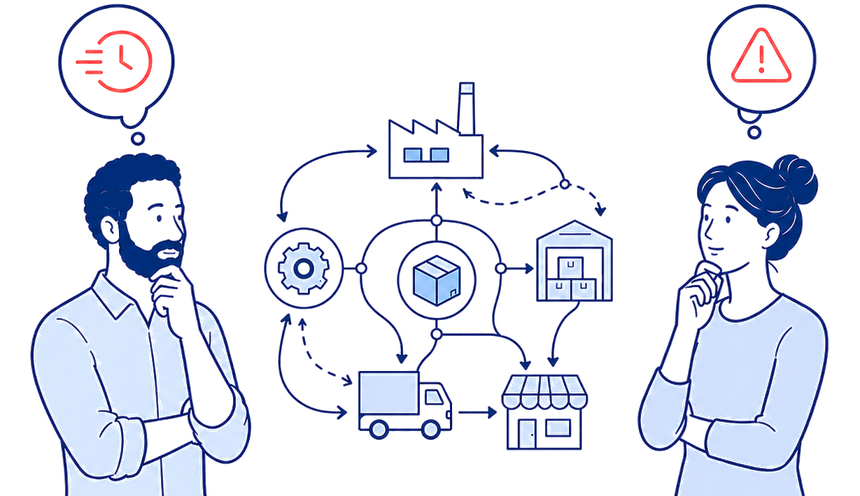
A shifted order collides with other orders, supplier lead times and a plant already at capacity.
check first
Buffers that look wasteful on a spreadsheet are often the only thing protecting service and revenue.
trade-off
One new component can affect lead times, qualifications and supplier capacity across the whole chain.
consequences early
By the time a risk shows up in the numbers, the decisions that caused it were made months earlier.
questions
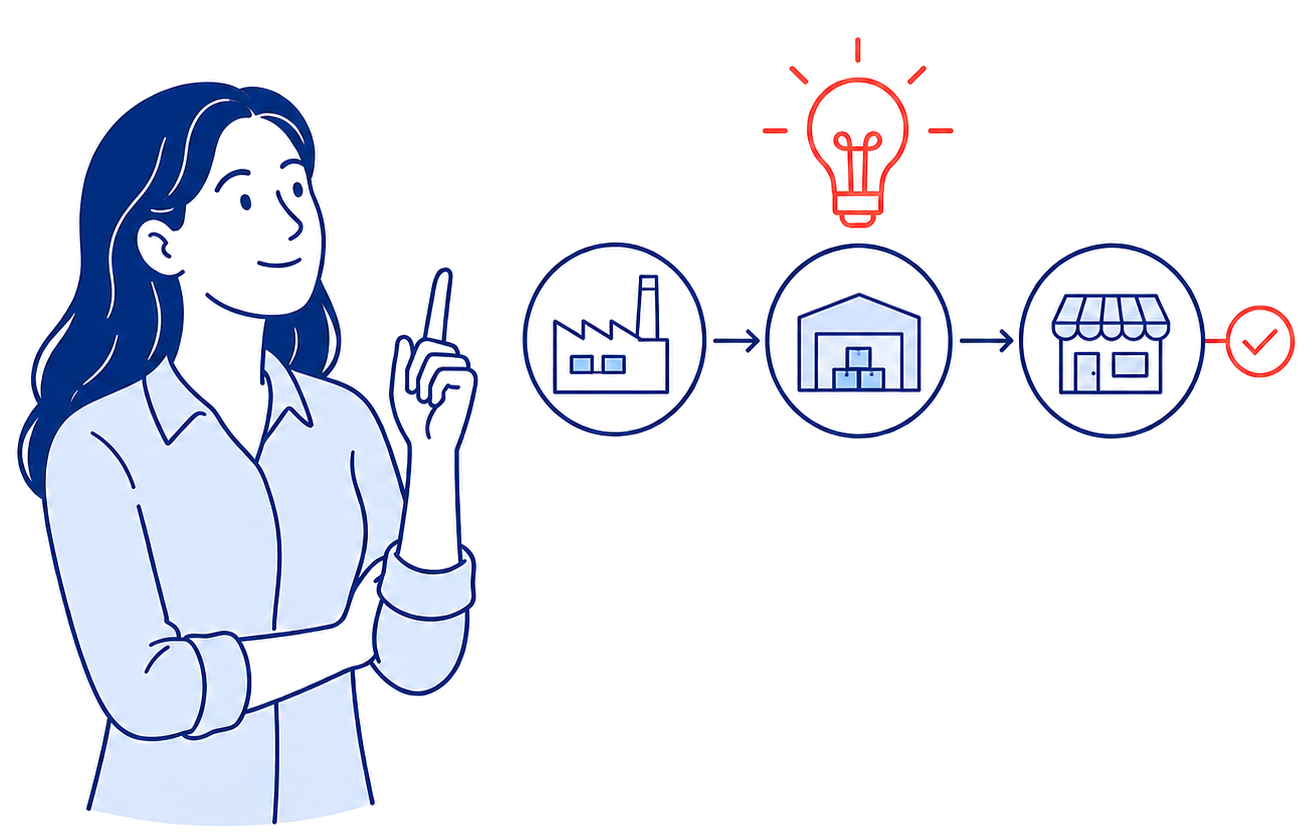
Understand these dynamics and you stop reacting to the supply chain - start shaping the decisions that run through it now!
Learn how supply chains really work and why they matter to everyone.
Not to make you a supply chain expert, but to give you the literacy to engage with everyone dealing with supply chains.
Sales & Commercial
Make credible promises to customers and understand what's really possible before you commit.

Finance & Controlling
See why inventory, service and cost pull against each other — and where the real levers sit.

R&D & Engineering
Anticipate how design and sourcing choices ripple into cost, lead time and resilience.

HR & People
Understand the roles, pressures and skills that make supply chain teams succeed or stall.

Executives & the Board
Ask the questions that surface risk early, and judge supply chain strategy with confidence.
Cross-functional teams
Prepare for large, complex projects where every function's decisions collide in the chain.
Why you benefit from this course
Knut Alicke explains in two minutes why you will benefit from this course as this course designed specially for people outside supply chain.
Supply Chains are LUNA
The four microfoundations
Supply chains are Linked, Uncertain, Non-linear, and Ambiguous — LUNA. These four characteristics explain why well-intended decisions can trigger unexpected consequences elsewhere.
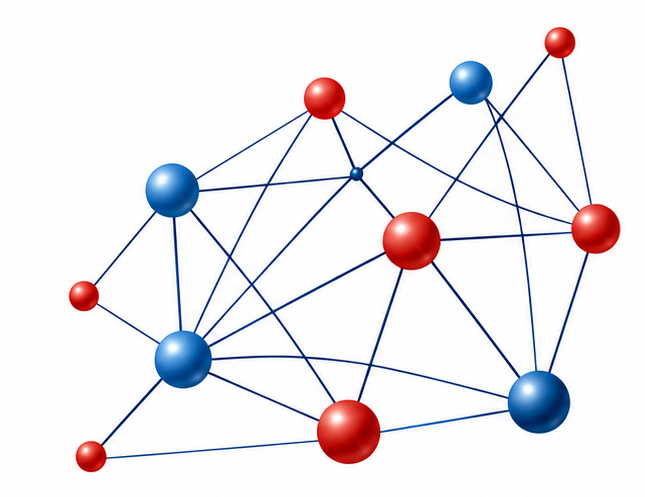
Linked
Decisions rarely stay within one function, site or company. A local choice can create consequences upstream with suppliers, internally in operations, or downstream with customers.
- →Who else will this affect?
- →Which upstream or downstream processes will be impacted?
- →Who should be involved before we decide?

Uncertain
Plans are based on assumptions that may not hold as predicted. Many key factors like demand, supply, lead times, quality, and capacity are affected by randomness and vary.
- →What could vary?
- →What assumptions are we making?
- →What happens if our forecast or plan is wrong?

Non-Linear
Small changes can create disproportionate effects. A minor demand increase, product change, or delay can trigger stockouts, expediting, overtime, or service failures.
- →Could a small change trigger a large effect?
- →Are we close to a capacity, inventory, or lead-time threshold?
- →Could this decision create a bottleneck or ripple effect?

Ambiguous
There is often no single 'right' answer. The same decision can look good for one function but problematic for another because service, cost, inventory, resilience, and sustainability interact.
- →What trade-offs are we making?
- →What looks good locally but may hurt the overall business?
- →Which performance dimension are we prioritizing and which are we sacrificing?
The four microfoundations are based on scientific research as outlined in Kai Hoberg, Rico Merkert, Charlien Wendling, Kimo Bruns, 2026. Linked, Uncertain, Non-linear, and Ambiguous: Are L(U)NA attributes of Supply Chain Management Embedded in Executives DNA? Working Paper, Kühne Logistics University/University of Sydney.
Simple, spicy and sticky.
Three principles that shape every module of the course as it is built for busy people like you.

Simple
No jargon, no formulas. Just the essence of how supply chain logic actually works

Spicy
Provocative, energizing, full of "aha" moments that change how you see the next meeting.

Sticky
Designed so the ideas stay with you — easy to recall, easy to use on Monday morning.
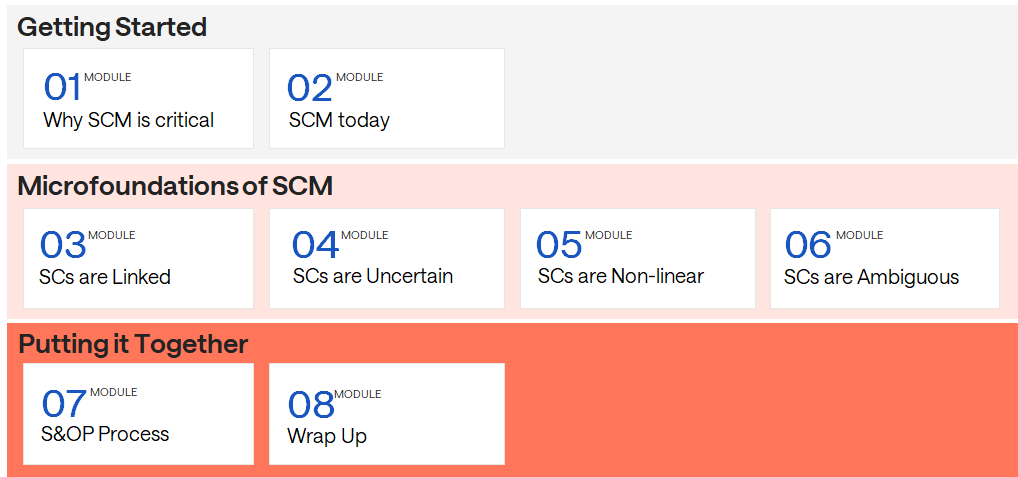
Eight modules:
Full of short videos and fun microtasks
A compact course for non-SCM managers that enables them to successfully interact with SCM.
Meet your instructors
Two leading voices in supply chain management — combining academic rigor with real-world practice.


Ready to boost your supply chain management understanding?
Join managers, experts and specialists who want to make better decisions in a world where supply chains drive everything.
- Eight focused modules with videos and microtasks
- Self-paced, ~5 hours in normal interaction
- Special introductory pricing for early participants
- Certificate of completion from Kühne Logistics University
Get early access
Be among the first to enroll when SCM for Everyone opens to the public. Join the waitlist and be the first to know when enrollment opens.
Bring SCM for Everyone to your organization
Run the program with your team, function, or leadership group. We can discuss cohort delivery, customization, and company-wide access.